Your Tool Scans.
Lane Pilot Diagnoses.
Drop an Autel, TOPDON, Launch or Snap-on report — or a VCDS Auto-Scan, ISTA export or SDD fault table — into the chat. Lane Pilot parses every module, correlates cross-system faults, and delivers a complete diagnosis with the exact tool paths to fix it.
Import is free on every account · diagnosing an import uses a session · Works alongside the scan tools you already own
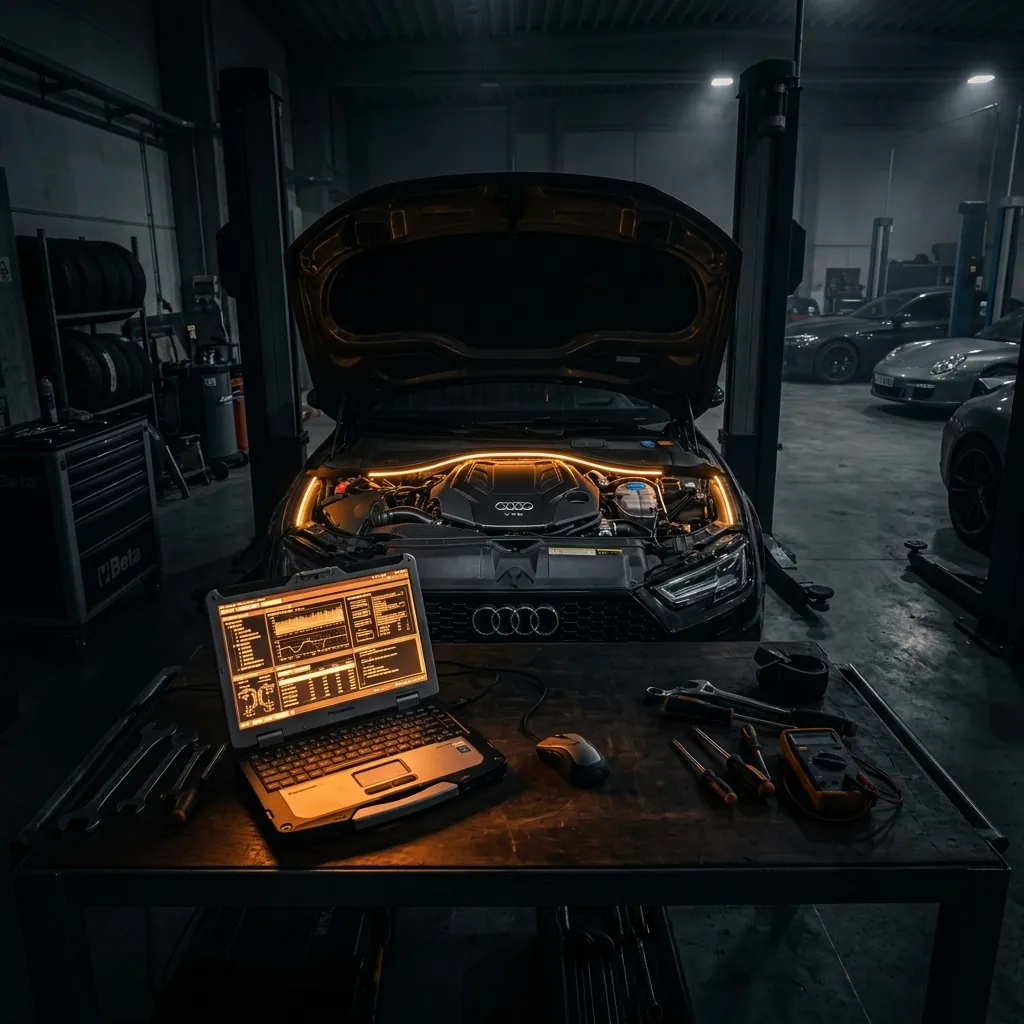
Your Scan Tool Has a Blind Spot.
VCDS shows you what's stored. ODIS walks you through a flowchart. ISTA lists the faults. But none of them tell you what the faults mean together — or what to do when the flowchart runs out.
A modern VAG vehicle has 18+ networked control modules. VCDS shows each one in isolation. Lane Pilot correlates them into a single root cause.
VCDS, OBDeleven, ISTA, SDD — none of them interpret faults. They display data. You still need to be the expert.
Keep your $299 VCDS. Keep your $750/yr ODIS. Add Lane Pilot for $89/mo and every scan becomes a diagnosis.
Four Steps. Zero Workflow Changes.
You already know how to run your scan tool. Now just paste the output.
Scan with your existing tool
Run the all-system scan on the tool you already own — Autel, TOPDON, VCDS, ISTA, whatever is on the bench — exactly as you normally would. No workflow changes.
Drop or paste into Lane Pilot
Save the .txt/.xml file and drop it into the chat — or just copy the output text and paste it. Lane Pilot auto-detects the format.
Engine correlates and diagnoses
The Diagnostic Engine cross-references every module, correlates multi-system faults, and cites the exact VCDS channels to fix it.
Get a complete repair plan
Ranked failure probabilities, quick-check tests, parts forecast, SVG connector diagrams, and a post-repair protocol — DTCs to clear, relearns to run, drive cycle to complete. Where a component is implicated you can ask for the Remove & Replace procedure in the same thread: ordered steps, torque values marked ⚠ verify, and a safety block added by rule when the job enters a hazard zone.
Watch it read your scan
Pick a tool. The raw export on the left is what you paste; the payload on the right is what the parser hands to the Diagnostic Engine.
Autel MaxiSYS Ultra          SW: V3.60.11
Serial: 4A72900316
VIN: 1FTFW1ET5DFC10312
Vehicle: 2013 Ford F-150 3.5L EcoBoost

===== Auto Scan Results (38 systems) =====
PCM   Powertrain Control Module ....... 2 Fault(s)
TCM   Transmission Control Module ..... 1 Fault(s)
ABS   Anti-Lock Brake System .......... No Fault
RCM   Restraint Control Module ........ Not Equipped

----- PCM Powertrain Control Module -----
P0016  Crankshaft/Camshaft Position
       Correlation Bank 1 Sensor A      [Stored]
P0299 Turbocharger Underboost [Stored]format: 'autel'- vin
- "1FTFW1ET5DFC10312"
- vehicleInfo
- { make: "Ford", model: "F-150", year: 2013 }
- dtcs_stored
- ["P0016", "P0299", "P0715"]
- module_scan
- 38 systems · 2 with faults · 1 not equipped
- dtcs_detail
- 3 records, each with module + status
- oem_metadata
- { tool: "Autel MaxiSYS/MaxiCOM", sw_version: "V3.60.11" }
- freeze_frame
- AutoScan summary PDFs do not carry freeze frames
- live_pids
- not available from a static export
Parsing… The extracted payload is what reaches the Diagnostic Engine — the root cause and the test plan come from that next step, not from the parse.
Three warnings the model cannot forget
When a Remove & Replace procedure enters a hazard zone without stating the mitigation, a deterministic rule injects it. Not a prompt instruction the model can drift from — a check that runs over the finished reply.
High voltage
A procedure touching orange-cable components with no de-energize step gets one: service disconnect, manufacturer discharge time, 0 V verified at the HV bus with a CAT III meter, Class 0 gloves.
SRS / airbag
Work near pyrotechnic components without a battery-disconnect step gets the standby requirement stated — negative terminal off, manufacturer standby time waited, before touching a clockspring or pretensioner.
Fuel system
Opening a fuel line with no depressurization step gets the relief protocol, because a high-pressure GDI rail holds dangerous residual pressure long after shutdown.
Each injected block says so on its face — “added by a deterministic safety rule, not the model” — so a technician always knows which words came from where.
Supported Tools
Drop a file or paste text. Lane Pilot auto-detects the format.
Universal aftermarket scanners
The tools most general shops already have on the bench.
Autel MaxiSys / MaxiCOM
featuredParses all-system topology scans, stored and pending DTCs, freeze frames and sensor readings across powertrain, chassis and body networks.
TOPDON Phoenix / TopScan
Extracts full vehicle system scans, DTC status flags and live PID snapshots, feeding multi-module telemetry straight into the Diagnostic Engine.
Launch X431 Series
Read through the universal extraction ladder: text and DTCs are pulled from the report, without a Launch-specific parser. Module grouping and freeze-frame structure may not survive.
Snap-on ZEUS / TRITON
Read through the universal extraction ladder: text and DTCs are pulled from the report, without a Snap-on-specific parser. Module grouping and freeze-frame structure may not survive.
Factory & OE specialist tools
Dealer-level software, read at full depth.
Ross-Tech VCDS
featuredParses all Address blocks, VAG 5-digit + P/B/C/U codes, freeze frames, ECU coding, and component IDs. The Diagnostic Engine names VCDS module paths and adaptation channels in its answer; confirm them in VCDS before you run them.
BMW ISTA / Rheingold
Extracts full ECU identification (SGBD, I-Level, HW/SW versions), all DTCs with freeze frames, test plan results, and fault priorities.
JLR SDD / Pathfinder
Handles SDD sub-fault codes (P0562-00 format), Historic/Active status, and auto-detects Land Rover vs. Jaguar from VIN prefix.
VAG ODIS
Parses ODIS XML and plain-text exports. Handles legacy 5-digit VAG fault codes and modern UDS DTCs. Supports all VAG brands.
What Your Scan Tool Can't Do.
Every feature below activates automatically when you import scan data.
Cross-Module Correlation
VCDS shows you faults per module. Lane Pilot correlates U0100 in Module 01 + B1234 in Module 09 + C0045 in Module 03 into a single root cause: bad ground strap at G200.
VCDS Channels Inline
The Diagnostic Engine names the VCDS path it has in mind, such as "Module 01 → Basic Settings → Group 060". Confirm it in VCDS before you run it.
Post-Repair Protocol
After every diagnosis: DTCs to clear (by module), relearns to run, Basic Settings to initialize, drive cycle to complete, torque re-checks. Zero comebacks.
ODIS-Required Warnings
The Diagnostic Engine clearly flags when a procedure requires ODIS with online SVM access — component protection, immobilizer, SFD gateway. No guessing.
Vision Inspector
Upload a photo of a corroded connector or suspect component. Lane Pilot identifies it, overlays pin-outs, and ties it to the fault pattern.
Lane Pilot is a diagnostic companion — not a replacement.
We don't do module programming, ECU flashing, component protection, immobilizer coding, or SFD gateway unlocking. Those require ODIS with online SVM access, ISTA with ICOM, or an authorized dealer connection.
Lane Pilot tells you what's wrong and how to fix it. Your OEM tool handles the programming after.
Every Scan Tool Owner Needs the Engine.
Keep your VCDS. Keep your ISTA. Add the intelligence layer that turns raw data into repair plans.