Stop Walking to
the Shop PC.
Upload a photo. Get it back untouched — with overlays on the components that matter to the diagnosis. Tap a bounding box for the part name and its severity grade. Built for greasy fingers.
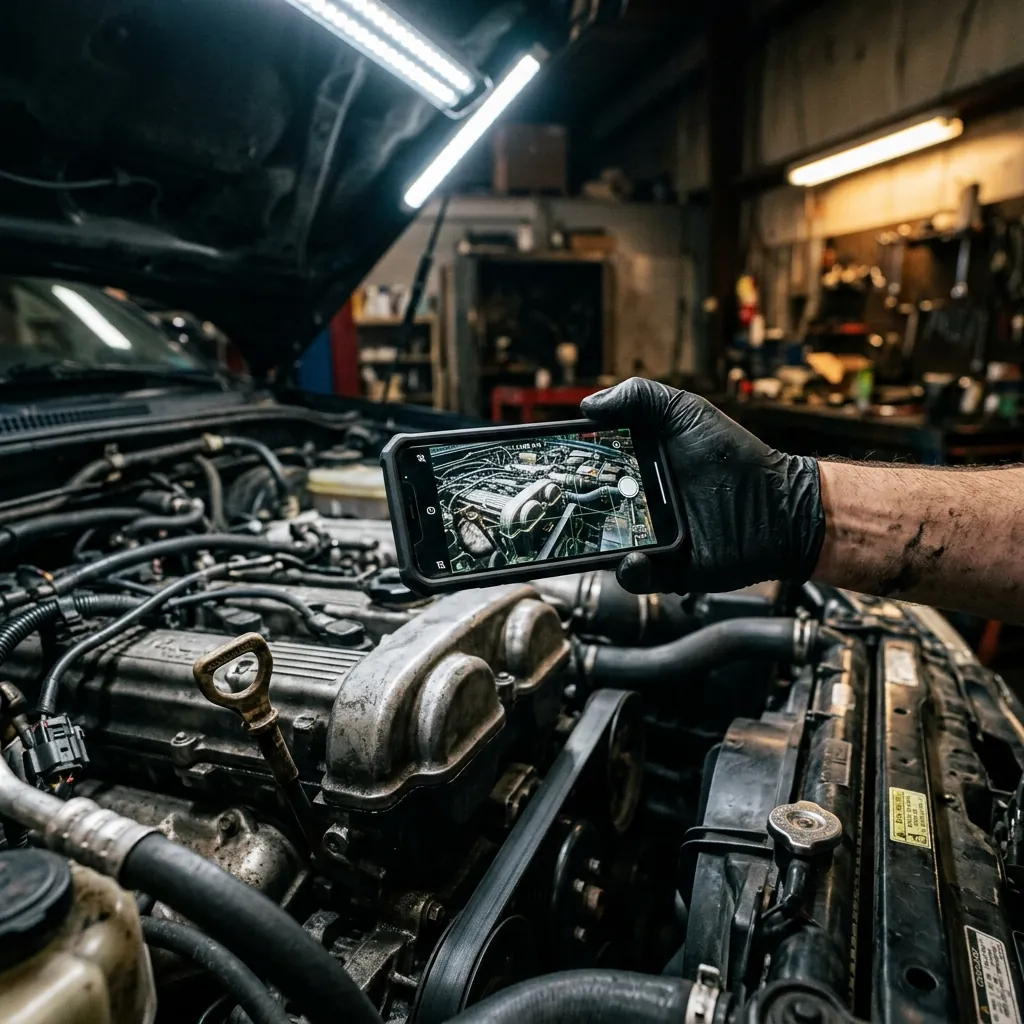
Photo In. Findings Out.
Send a photo of a connector or component. The Diagnostic Engine says what it can see, what it can’t, and the check that settles it. Pin and fuse numbers come from your wiring diagram — send it, and it reads the diagram with you.
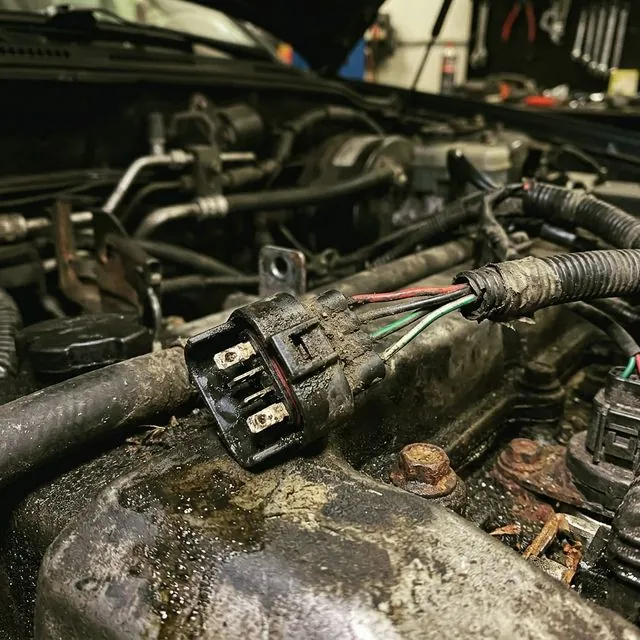
What's the pinout for this TPS connector?
2:23 PM
Unplugged 4-terminal sensor connector
- Seen
- Heavy oil and grime on the connector body and around the terminals. The loom is pulled back, leaving the four wires exposed behind it.
- Not visible
- Which terminal is reference, signal or ground, and whether the terminals are corroded inside the cavities. Pin numbers don’t come from memory — a wrong pin can cost a module. Send the wiring diagram page and it reads it with you.
- Next check
- Clean the terminals, then key on and back-probe each one against the values on that diagram.
Seen · not visible · next check · Visual Repair Intelligence
What comes back from a photo
Pick a failure. The card on the right is the shape the inspector really returns.
Deep circumferential scoring across the full swept area with heat-checked bluing near the outer edge. Pad backing has contacted iron; the scoring depth exceeds what a resurface can remove on a rotor already near minimum thickness.
Measure thickness against the discard spec stamped on the hat before quoting a resurface.
Severity, what the photo shows and the component come back as written analysis — not pixel coordinates. There is no confidence percentage: nothing measures one, so each finding ends with the check that confirms it on the vehicle.
Built for the Bay. Not the Boardroom.
Three things that matter when you've got a customer waiting and grease on your hands.
Your Photo Is Never Redrawn
Other tools run your image through a generative model and can turn a red wire green. Lane Pilot never does — there is no image generation anywhere in the stack. Your original is displayed untouched with a separate SVG overlay drawn on top, so what you see is the photo you took.
Detect, Then Overlay
The pipeline returns normalized bounding-box coordinates and draws them over your untouched photo — no round trip through an image generator. Snap, ask, answer while you're still standing at the car.
Included on Day One
This isn't locked behind an enterprise paywall. Every paid plan — from $89 Solo Pro up — includes Visual Repair Intelligence with Annotated Photo Return. Solo techs get the same firepower as a 10-bay shop.
It Listens, Too.
The camera is one sensor — your phone's mic is another. Acoustic NVH runs envelope-spectrum analysis anchored to RPM, splitting 0.5× valvetrain orders from 1.0× bottom-end.
Confidence-gated: when the signal isn't clean enough to call, it stays quiet. The numeric digest spools offline and syncs when the shop WiFi comes back — the audio never leaves the device.
See it in the Service Bay GuideStop Guessing. Start Seeing.
Visual Repair Intelligence is included in every plan. No upcharge. No add-on. Day one. Acoustic NVH rides along — eyes and ears, same plan.
Plans from $89/mo · Shop trial: 30 days, 50 diagnostic sessions, no credit card · Start the trial